



Online gambling is restricted to adults for good reason. For anyone under 21 (or 18, depending on the state), gambling carries outsized risks, from financial harm to the development of addictive behaviors during a period when impulse control and decision-making are still maturing.
This guide explains how licensed U.S. online casinos verify age, what enforcement actually looks like when those systems fail, and what parents and guardians can do to protect minors from accessing gambling content on shared or personal devices.
The reason goes beyond compliance. The numbers tell a clear story:
- A March 2026 national survey conducted by The Harris Poll on behalf of the NCPG found that 65% of U.S. adults aged 21 and older reported participating in at least one form of gambling before turning 21. Among those who gambled underage, 40% played lottery or scratch-off tickets, 37% took part in home games for money, and 23% placed a sports bet.
- The same survey found a sharp generational divide: 33% of adults aged 21-44 said they placed a sports bet before age 21, compared with just 11% of those 55 and older. Online casino play before 21 was also significantly higher among younger adults.
- Research published in the Massachusetts Problem Gambling Awareness campaign found that children introduced to gambling by age 12 are four times more likely to develop problem gambling later in life.
- Problem gambling prevalence among adolescents (6-8%) is roughly three to four times higher than among adults (1-2%), according to multiple studies cited by the NCPG and the Council on Compulsive Gambling of New Jersey.
- The NCPG’s NGAGE 3.0 national survey (2024) found that nearly 20 million U.S. adults report experiencing at least one problematic gambling behavior, with younger adults and sports bettors at disproportionately higher risk.
- 66% of Americans say they are concerned about underage exposure to gambling or gambling-like activities, including sports betting ads, online games with betting elements, and loot boxes. That concern rises to 71% among households with children under 18.
The adolescent brain isn’t built to weigh gambling risks the way an adult’s can, the regions responsible for impulse control and consequence evaluation don’t fully mature until the mid-20s. Gambling during that window can establish compulsive patterns that are hard to reverse.
Licensed U.S. operators must implement specific safeguards by law. Offshore sites typically have none. Add loot boxes, skin betting, and social casino apps into the mix, and the line between gaming and gambling has blurred significantly for younger audiences. The NCPG’s 2026 survey identified these gambling-adjacent features as a top concern among parents.
How Licensed Online Casinos Verify Age
Step 1 – Account registration
When you create an account, you’re asked to provide your full legal name, date of birth, home address, the last four digits of your Social Security number (or full SSN, depending on the operator), and an email address. This information is cross-referenced against third-party identity databases in real time.
If the data doesn’t match, say, the name and date of birth don’t correspond to any known identity record, the registration is flagged or rejected before the player can proceed.
Step 2 – Document verification
Most operators require you to upload a government-issued photo ID (driver’s license, passport, or state ID card) either during registration or before your first withdrawal. Some platforms also request a selfie for facial matching, the system compares the face in your uploaded ID to a live photo taken through your device’s camera.
This step catches attempts to use stolen, borrowed, or forged documents. Advanced systems include liveness detection, which verifies that a real person is present (not a photo of a photo, a deepfake, or a static image).
Step 3 – Address and payment verification
Operators may request proof of address (a recent utility bill, bank statement, or government letter) and will verify that payment methods are registered in the player’s name. You can’t deposit with someone else’s credit card or bank account, the payment source must match the verified account holder.
Step 4 – Geolocation
In addition to identity, licensed platforms use geolocation technology to confirm you’re physically located within a state where online gambling is legal. This happens every time you log in or place a bet. Geolocation also creates an additional barrier for minors: even if a minor manages to pass identity checks, they’d need to be physically within a legal state, which limits access.
Step 5 – Ongoing monitoring
KYC isn’t a one-time event. Operators continuously monitor accounts for behavioral anomalies: unusual login patterns, sudden changes in deposit amounts, attempts to create duplicate accounts, or transactions that don’t align with the player’s profile. Accounts flagged during monitoring may trigger re-verification or suspension.

What happens if a minor slips through?
If an operator discovers that a minor has accessed their platform, whether through a false identity, using a parent’s account, or any other means, the account is immediately frozen. Any deposited funds are returned to the original payment method. Winnings are voided. The operator is also required to report the incident to the relevant state gaming commission.
Enforcement: What Happens When Casinos Fail
Valley Forge Casino Resort, Pennsylvania (2025)
The Pennsylvania Gaming Control Board (PGCB) fined the operator of Valley Forge Casino Resort $30,000 after a 13-year-old gained entry to the gaming floor in November 2024 and was able to gamble on slot machines for more than six hours before being detected. The case was resolved through a formal enforcement action, and details are publicly available through the Board’s Office of Communications.
This is a land-based example, but the principle is identical for online operators. If a minor bypasses digital verification and accesses real-money games, the operator faces the same regulatory scrutiny and often steeper penalties because the KYC systems are expected to be more rigorous in the digital environment.
Atlantic City, Combined Underage Access Penalties (2024)
Multiple Atlantic City casinos faced combined penalties of $5.4 million for underage access violations in 2024, according to enforcement data compiled by industry compliance monitors. These actions targeted failures in both floor-level age checks and digital entry points, reflecting a broader pattern of regulators holding operators accountable for the full scope of their access controls.
Caesars Entertainment, KYC Failures (2024)
While not exclusively an underage gambling case, Caesars Entertainment was fined $4.2 million in 2024 for systematic KYC failures, the same verification processes that are designed to prevent underage access. When KYC breaks down, age verification breaks down with it. Regulators treat these as inseparable.
What the pattern shows?
A few themes are worth noting:
Fines for KYC failures are increasing. As the online gambling market matures, regulators are becoming more sophisticated in their audits. Increasingly, regulators are also scrutinizing age verification practices and responsible gambling tool implementation.
Operators lose more than money. A public enforcement action damages an operator’s reputation, which in turn affects player trust, partnership opportunities, and market position. The reputational cost often exceeds the fine itself.
Self-reported violations are treated differently. Operators who discover a minor on their platform and report it proactively to the gaming commission generally receive more lenient treatment than those caught during a compliance audit. This creates an incentive for operators to police their own systems.
For readers interested in how specific casinos and platforms perform on compliance, our casino reviews include assessments of licensing, KYC practices, and responsible gambling tool availability.
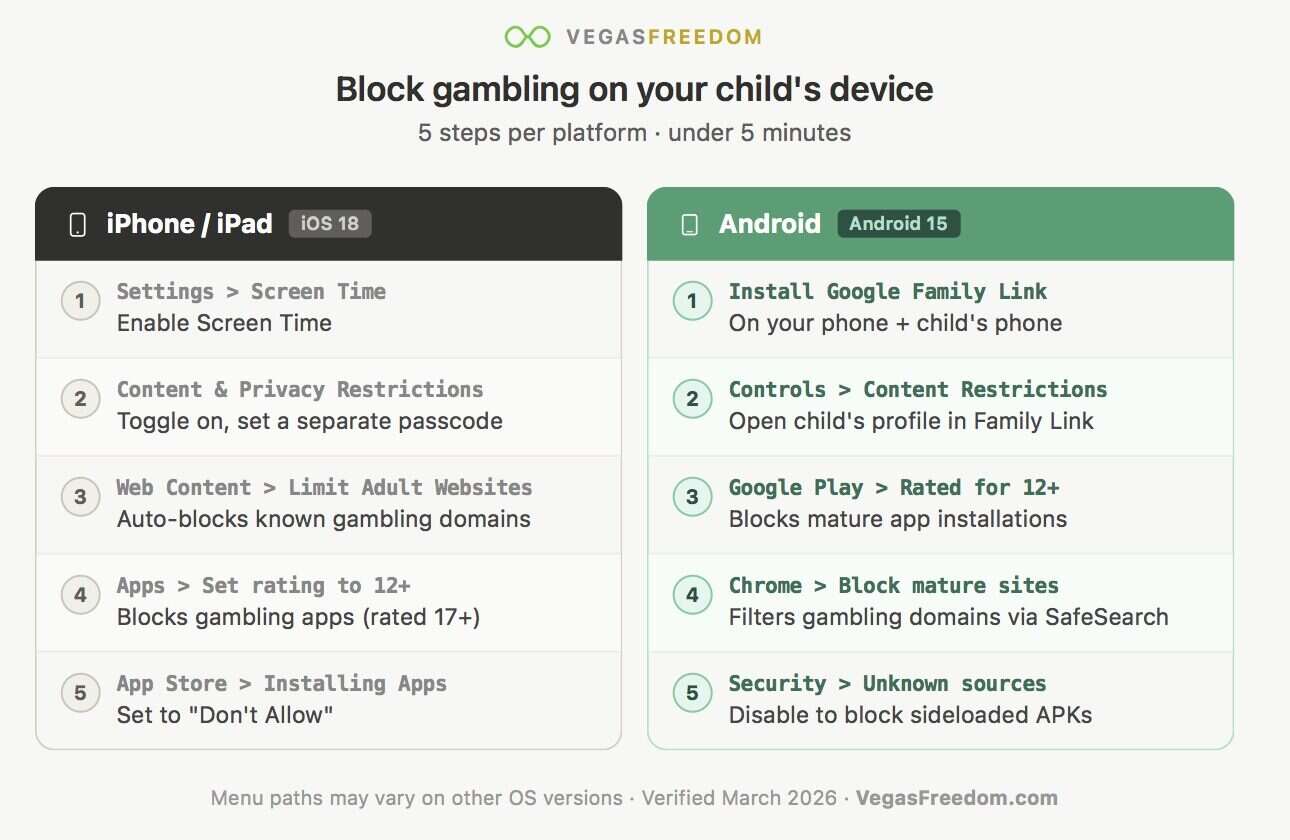
On iPhone and iPad (iOS)
Apple’s Screen Time settings include content restrictions that can block gambling apps and websites.
- Open Settings > Screen Time > Content & Privacy Restrictions
- Turn on Content & Privacy Restrictions (set a separate passcode that your child doesn’t know)
- Tap Content Restrictions > Web Content and choose Limit Adult Websites, this automatically blocks known gambling domains
- Under App Store, you can also restrict app downloads by age rating, set the rating to 12+ or lower to prevent gambling app installations
- For additional control, go to App Installations and toggle off the ability to install new apps without your approval.
On Android devices
Google’s Family Link app provides similar controls for Android devices.
- Install Google Family Link on your phone and your child’s phone
- In Family Link, go to Controls > Content Restrictions
- Under Google Play, set the content rating for apps and games to block mature content
- Under Google Chrome, set the browsing filter to Try to block mature sites
- For added protection, restrict your child’s ability to install apps from unknown sources, go to Settings > Security> disable Install from unknown sources.
Browser-level and network-level blocks
If your child uses a laptop or desktop computer, you can add protection at the browser or network level:
- BetBlocker (betblocker.org) is a free, nonprofit tool that blocks over 90,000 gambling websites across all major platforms. It includes a parental control mode specifically designed for this purpose. Once activated, the block cannot be removed without a separate authorization process.
- Gamban (gamban.com) blocks over 100,000 gambling sites and apps, with multi-device coverage under a single license.
- Router-level DNS filtering services like OpenDNS Family Shield (free) can block gambling content at the network level, covering every device connected to your home Wi-Fi. This means even devices without individual parental controls are protected.
On a licensed U.S. platform: Contact the operator’s customer support team directly and report the issue. Licensed operators are required to investigate and take action, including freezing the account and refunding deposits. You can also file a complaint with the state gaming commission in the relevant jurisdiction.
On an unlicensed or offshore platform: These sites are not subject to U.S. state regulation, which makes enforcement more difficult. However, you can still report the site to the NCPG, the Federal Trade Commission (FTC), or the Internet Crime Complaint Center (IC3). If a child has suffered financial harm, contact your bank or card issuer to dispute the charges.
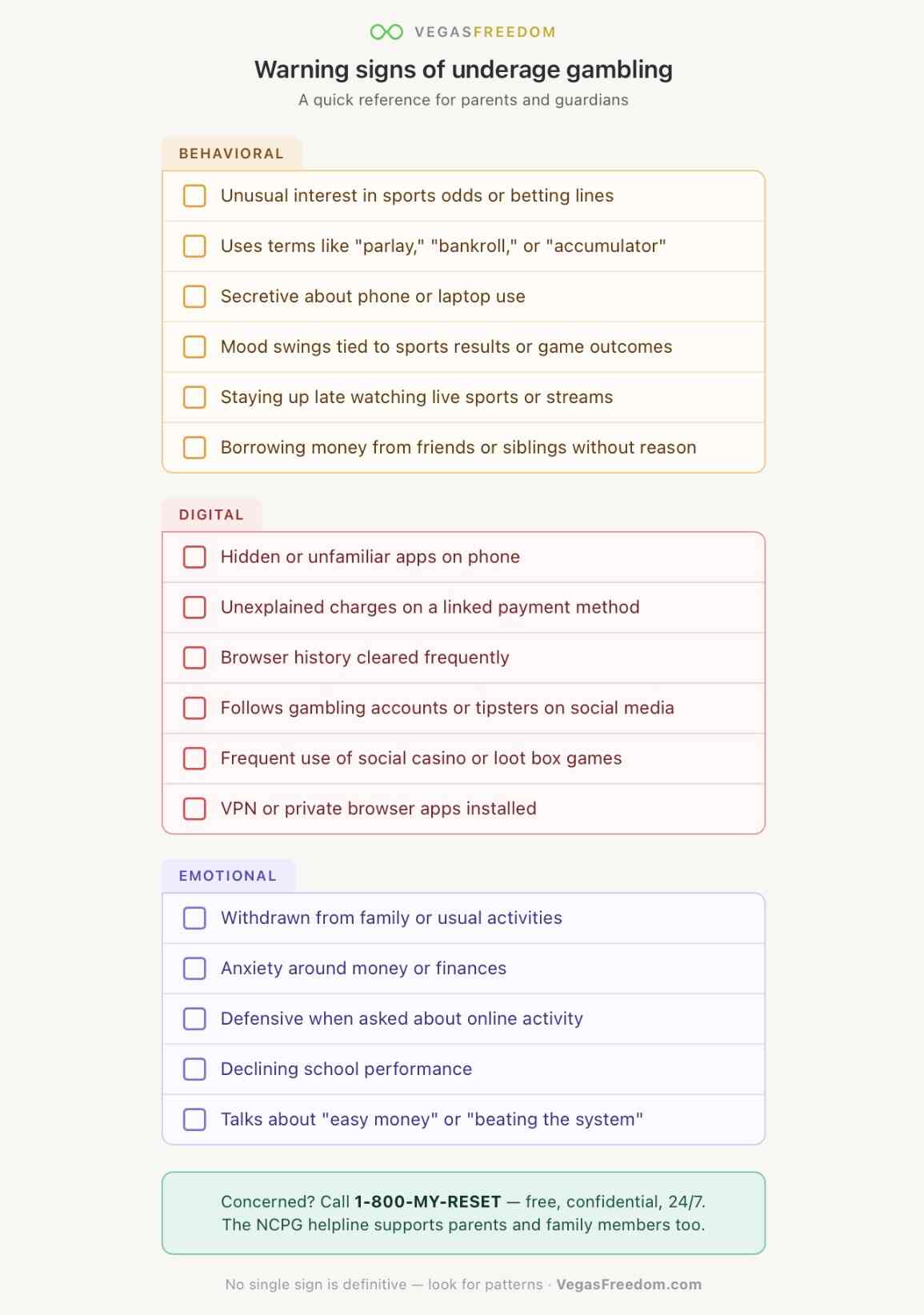
If a child is showing signs of problem gambling: Reach out to the National Problem Gambling Helpline at 1-800-MY-RESET (1-800-697-3738). The helpline supports both individuals and family members, and can connect you with local counselors who specialize in youth gambling issues. You can also text 800GAM or chat at NCPGambling.org/chat. For more support options, see our Get Help Now page.
Quick Reference: Key Numbers and Tools
| Resource | Contact / Link |
| NCPG Helpline | 1-800-MY-RESET (call), 800GAM (text), NCPGambling.org/chat |
| BetBlocker (free, with parental mode) | betblocker.org |
| Gamban | gamban.com |
| Apple Screen Time | Settings > Screen Time > Content & Privacy Restrictions |
| Google Family Link | Available on Google Play and App Store |
| OpenDNS Family Shield | opendns.com/home-internet-security |
| FTC complaint | reportfraud.ftc.gov |
| IC3 (Internet Crime) | ic3.gov |
Frequently Asked Questions
What is the legal gambling age for online casinos in the U.S.?
In most states with legal online casino gambling, including New Jersey, Pennsylvania, Michigan, West Virginia, Connecticut, and Delaware, the minimum age is 21. A small number of jurisdictions allow certain forms of betting (such as lottery or horse racing) at 18.
Can a minor use a parent's account to gamble?
Technically, a minor could access a parent’s account if they know the login credentials and have physical access to the device. This is a violation of the operator’s terms of service and, in many states, a legal violation as well. Operators use behavioral monitoring to flag unusual patterns that might indicate account sharing. Parents can prevent this by using strong passwords, enabling two-factor authentication, and never saving login credentials on shared devices.
Are social casino apps (play-money games) considered gambling?
Under current U.S. law, most social casino apps are not classified as gambling because they don’t involve real-money wagering with a direct cash-out. However, they replicate the look, feel, and mechanics of real gambling, including slot machines, poker, and blackjack. Research suggests that regular use of social casino apps is associated with a higher likelihood of transitioning to real-money gambling. Parents should treat these apps as a form of gambling exposure, even if they’re technically free-to-play.
What should I do if I find gambling apps on my child's device?
Remove the apps, then have a conversation about what prompted the interest. Check for any linked payment methods or charges. If real money was spent, contact the app store (Apple or Google) and your bank to request a refund. Review and tighten the device’s parental controls using the steps outlined above. If you’re concerned about a developing pattern, the NCPG helpline (1-800-MY-RESET) can provide guidance.
Do offshore or unlicensed casinos verify age?
Most do not, or their verification is minimal and easily bypassed. This is one of the key reasons we recommend playing only at licensed, state-regulated platforms. Licensed operators face real consequences for allowing underage access. Unlicensed sites face none.
This page is reviewed and updated quarterly by the Vegas Freedom editorial team. All resource links, parental control instructions (verified for iOS 18 and Android 15), and regulatory information were verified by our staff through direct contact confirmation as of 2026. If your device runs a different OS version, menu paths may vary slightly. If you believe any information on this page is outdated, please contact us.